

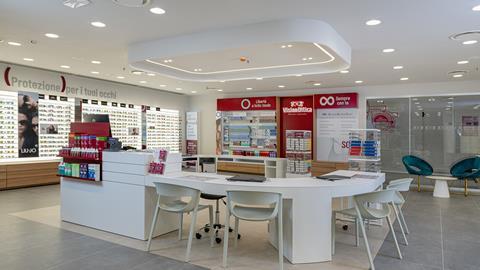
Vision Group, one of Italy’s leading eyewear retailers, aims to expand its domestic footprint further before looking at eventual growth opportunities further afield. Marco Procacciante, CEO, talked to Eyewear Intelligence about Vision Group’s growth plans, which are aimed at serving 85 percent of the Italian population with a VisionOttica store that can be reached in 15 minutes or less.
Future expansion efforts will be backed by a new investor, as Italian private equity group Arcadia, which has owned a 46 percent stake since 2014, is preparing to exit. Procacciante, who is also the founder of Vision Group and the president of the majority shareholder VG Holding, says the process of identifying a new private equity investor to take Arcadia’s place is underway and a deal should be finalized in the first half of 2024. “We are working together with Arcadia to find an exit that is satisfactory for them and a new investor that will work well with us,” he says.
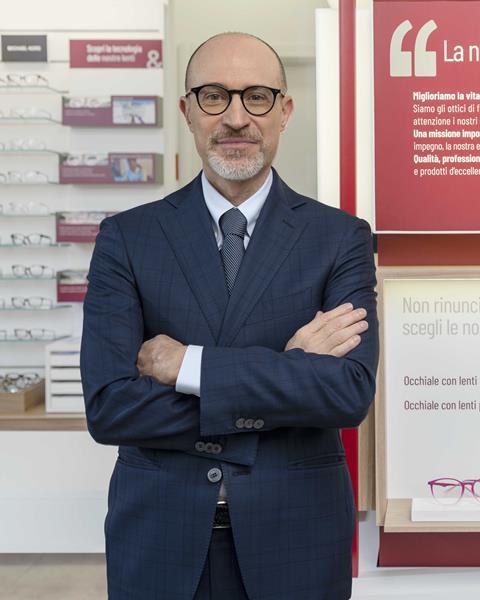
Vision Group currently has some 2,700 optical centers in Italy, including 200 directly owned stores and 300 franchises under the VisionOttica banner. The remaining 2,200 shops are independent, acting as a buying group and potential scouting ground for future VisionOttica stores. These shops are connected to Vision Group’s digital platform and central logistics system.
The group’s dimensions have grown significantly since Arcadia acquired its stake a decade ago. At that time, Vision Group counted on a fleet of 1,500 optical shops, including 210 under the VisionOttica banner. Revenues have roughly tripled, from about €56 million in 2013 to an estimated €165 million this year.
Procacciante says Vision Group aims to expand the number of VisionOttica stores – either franchises or owned stores – to 900 from the current 500. Whether a specific store will be directly owned or a franchise will depend on local conditions. Except in rare cases, new stores will not be opened from scratch but will be the fruit of acquisitions.
Vision Group made progress towards its growth objectives last year with the acquisition of 99 VistaSi stores and 75 GrandVision stores from EssilorLuxottica, divested as a condition for the European Commission’s approval of EssilorLuxottica’s acquisition of GrandVision. GrandVision stores have already been rebranded as VisionOttica. “In 2024, we’ll go ahead with investments in rebranding some VistaSi stores as VisionOttica while others will retain the VistaSi name and be subject to refurbishing and a repositioning of the offering,” says Procacciante.
Present in the community
This case-by-case approach is evidence of what Procacciante describes as Vision Group’s “glocal” strategy. “We have a global strategy at the national level, but we try to always be present in the local community with the idea of proximity.” To that end, the group’s product offering is adapted to fit the local market. For example, a shop in High Street location will feature more design-oriented eyewear.
The group focuses on the medium and high segments of the market for eyeglasses and contact lenses. “We have a wide selection of industrial brands and private labels, depending on the local needs,” says Procacciante. Even with products at the very top of the market, there is always “a lot of attention to the price-quality” relationship, he says.
The group’s private label activities are concentrated on contact and ophthalmic lenses at the high end of the market. Its private label lenses are produced in the laboratories of the industrial brands with which Vision Group collaborates, although Procacciante prefers not to name individual partners.
“Private labels are important, but alongside the brands,” stresses Procacciante. While over 50 percent of the group’s ophthalmic lens sales are from its own labels, for example, offering brand eyeglass frames is key for the mid-market to high-end segments of the market the group targets.
A big opportunity
The manager still sees a “big opportunity” for consolidation in Italy, and Vision Group intends to continue to act as a consolidator. Procacciante points out that most optical centers in Italy remain independent, family-owned operations. “Perhaps the owner’s children don’t pursue the same profession and when they retire, we provide continuity by acquiring these centers, which are sometimes already affiliated with us,” he says.
Even with acquisitions stripped out, Procacciante says Vision Group has been growing this year at a slightly faster clip than the Italian market. Data from research group GFK for the first half of 2023 show business in the optical sales channel in Italy grew by 4.3 percent compared to the year earlier, with prescription eyewear sales up by 4.5 percent. “There’s been an increase in prices this year and while volumes for the overall market have been flat, we have also seen an increase in volumes in the segments we are more focused on,” he says.
While Vision Group’s business plan remains solidly focused on the Italian market, in the future Procacciante doesn’t rule out expansion in Southern European countries with similar characteristics to Italy, that is fragmented eyewear retail sectors and a penchant for eyewear with an element of fashion.
Digital investments
Aside from investments in new stores, Vision Group is also carrying out significant investments in the digital field. However, e-commerce potential is extremely limited in Italy given a regulatory framework that requires an optician to be on hand when prescription eyewear is delivered to the customer.
“We are investing instead on improving the customer journey, expanding the range of services that are offered,” explains Procacciante. Services offered include the virtual try-on of eyeglasses and the possibility of reserving eyewear online before finalizing the purchase in an optical shop, known as drive-to-shop. Increasingly, services are being made available to customers through subscriptions, he notes.
A competitive advantage
As is the case elsewhere, Italian retailers must contend with a shortage of opticians. Vision Group’s solution to that problem was to acquire an optometry school in Florence, the Scuola Internazionale di Ottica e Optometria (SIOO) in 2017. About 150 students a year attend the school, in addition to professionals already working in the sector, both at Vision Group and its retail competitors. SIOO is accredited by the region of Tuscany.
“We consider the school to be a competitive advantage,” says Procacciante. “It allows us to select new opticians for our stores but also to provide continuous training for our employees and affiliates.”
The group’s future could one day involve an initial public offering of its shares. “For a brand and a network like ours, it could make sense to list on the stock market,” says Procacciante. “But for this next step we are targeting a financial partner.”
Photos: Vision Group