
Wholesale sales of soft contact lenses rose by 5.2 percent year-on-year to €2,157 million in 2023 for a group of 32 countries including 25 in Europe and a few others (Egypt, Israel, Saudi Arabia, Kuwait, South Africa and United Arab Emirates), according to the new annual report by Euromcontact, the association representing the main manufacturers of contact lenses to the EU institutions.
Euromcontact members – Alcon, Avizor, Bausch + Lomb, CooperVision, Johnson &Johnson Vision Care, Mark’Ennovy and Menicon Europe – represent 90 percent of the soft contact lens market and 80 percent of the eyecare product market in the covered countries, the association notes.
As in previous years, Euromcontact further focuses on 11 European markets – Belgium, Denmark, France, Germany, Italy, the Netherlands, Norway, Spain, Sweden, Switzerland, UK & Ireland. Sales of soft contact lenses for this reduced group of countries increased by 3.8 percent year-on-year to €1,755 million in 2023.
Belgium and Luxembourg recorded a 16.2 percent growth, the highest increase rate among the group, followed by Sweden (+11.7 percent). Other countries are showing a slowdown or even a decline, like France where sales in value inched down by approximately 1 percent.
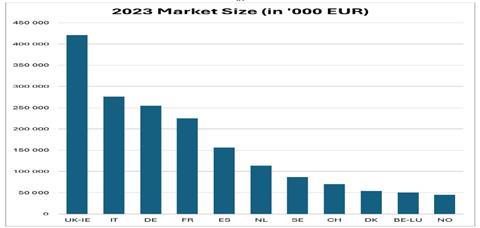
In Europe, the UK and Ireland remains by far the biggest soft contact lens market with wholesale sales of more than €400 million, followed by Italy (€270 million). In both markets, the share of daily contact lenses is very strong, but the UK and Ireland have a higher penetration rate of wearers among the population aged 15 to 64.
By categories, sales of daily disposable (DD) contact lenses grew by 4.3 percent, underperforming the monthly / bi-weekly contact lenses (+ 5.6 percent) in the 32-country group. As a result, the market share of daily disposable lenses slightly receded last year, going from 59.0 percent in 2022 to 58.9 percent in 2023. In the 11-country group, DD lenses slightly outperformed in value, with sales growing by 4.3 percent versus 2.8 percent for monthly and bi-weekly products.
It will be interesting to follow the evolution of the DD contact lenses’ market share over the next few years because last year’s data marks a break from the category’s solid growth in recent years. As a reminder, its market share stood at 55 percent in 2019 and 57 percent in 2021.
The DD contact lenses category’s growth was supported by several new product launches in the last few years, notably with the development of the multifocal and toric segments. The manufacturers price increases since the COVID period also boosted the value growth of the category in 2022. The fact that the category’s sales slightly decreased last year probably reflects a higher decrease in volumes sold.
Possible reasons for this slowdown include:
- lens wearers adjusting their consumption (wearing dailies less often, switching to monthlies or bi-weeklies) to difficult economic conditions. Indeed, the cost of daily contact lenses is at least 30 percent higher than the cost of monthly & bi-weekly contact lenses, according to Euromcontact
- a market moving towards private label contact lenses
- market share gains from manufacturers that are not members of Euromcontact
- discontinuation of some contact lenses, such as Trueye from Johnson & Johnson at the end of 2022
Across all markets covered by Euromcontact, the number of contact lens wearers was estimated at 20.4 million for 2023, up by 0.1 percent versus 2022. The estimation is based on an average usage of 350 lenses per year for daily contact lenses and 26 lenses per year for monthly & bi-weekly contact lenses.
In terms of contact lens wearer penetration rates and for the 11-country group, 2023 showed a slight increase to 6.4 percent (+0.5 percent). Behind this average, some markets like Belgium and Luxembourg, or Sweden, outperformed, with the number of wearers growing by 19.0 percent and 7.0 percent, respectively.
| Wearer penetration by country for population 15-64 years of age | ||
|---|---|---|
| Wearer base 2023 | Change vs. 2022 (number of wearers) | |
| Sweden | 13.15% | 8.55% |
| Denmark | 12.78% | -5.54% |
| Norway | 10.99% | -1.20% |
| The Netherlands | 10.75% | 0.88% |
| Switzerland | 9.09% | -5.92% |
| U.K & Ireland | 8.93% | 0.51% |
| Belgium & Luxemburg | 6.00% | 19.17% |
| Italy | 5.41% | -0.22% |
| Spain | 4.87% | 2.69% |
| France | 4.81% | -6.58% |
| Germany | 4.49% | 3.09% |
| Total 11 countries | 6.41% | 0.48% |
| Total 32 countries | 3.90% | 4.76% |
| Source : Euromcontact | ||
Sweden is the country among the eleven with the highest penetration rate of contact lens wearers (13.2 percent). Conversely, in some other countries like France, Denmark or Switzerland, the penetration rate declined significantly in 2023, by 6.6 percent, 5.5 percent and 5.9 percent, respectively.
Another criterion used by Euromcontact to evaluate the dynamics of the market is to follow the market share in value of the silicone hydrogel products for monthly- & bi-weekly contact lenses.
In recent years, silicone hydrogel products have been gaining market share in value but some markets showed a different trend in 2023, for example France, the UK & Ireland, Switzerland or Norway, with an increased share for hydrogel contact lenses.
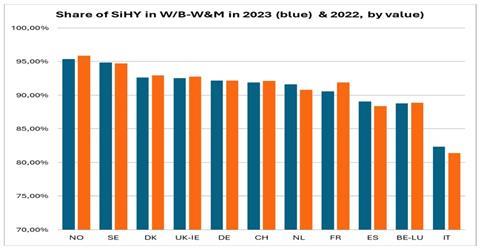
One possible explanation is that consumers turned to these contact lenses for their lower price tag. It is also worth noting that manufacturers strongly increased the price of hydrogel contact lenses last year to reduce the gap with silicone hydrogel cost, which must have mechanically increased the category’s market share in value.
According to industry insiders, these price increases are both the result of higher production costs for hydrogel lenses, as production investments focus on silicone hydrogel products, and a deliberate strategy to induce customers to switch to silicone hydrogel.
Euromcontact data on silicone hydrogel is currently limited to monthly and bi-monthly products. However, it would be interesting to know the share of the material in DD contact lenses, as it is increasingly being used in this segment.
In 2023, the lens care market showed a strong value increase of 4.8 percent for the eleven European countries of the panel. The slight rebound of monthly and bi-weekly contact lenses is one of the reasons behind the category growth, but it is also probably due to the fact that 2023 was more stable in terms of supply after several years marked by product recalls (Bausch + Lomb), production stoppages (CooperVision, Alcon, etc.), and repeated stock shortages (Alcon, Johnson & Johnson) which destabilized this market.